The Reality of Running a Gluten Free Small Business in Australia

Eight gluten free small business owners in Australia open up, revealing what running a business in the current market is really all about, and how you can help as the customer
Share this post:
Hey Gluten Free Fam,
Owning and operating a small business is hard at the best of times. For gluten free businesses, this is especially tough. There are additional challenges around ingredients, food safety, staffing and meeting the needs of a niche community that we often overlook.
With the cost of living putting the squeeze on local households, customers are understandably watching where they spend their money while business owners deal with inflation, impacting all the essentials including ingredients, wages, rent, fuel and taxes.
So, what does it actually look like behind the scenes?
On Episode 253 of A Gluten Free Podcast, Ben spoke with eight Australian gluten free business owners and creators about the reality of running their businesses, what keeps them going and how the gluten free community can support them.
This is a unique discussion that provides honest and raw insight into your favourite gluten free brands, and what they’re dealing with to deliver the products and services we love so much. We encourage you to listen to the podcast episode in its entirety on your platform of choice.
Thanking Our Gluten Free Small Business Participants
Before we begin, and in the spirit of supporting gluten free small businesses, we would love to acknowledge the owners who gave us their time and insights to give them a plug from the outset:
Anthony Dionne from Pasta Di Casa in Mosman, Sydney
Sebastien Syidalza from Sebastien Sans Gluten in Leichhardt, Sydney
Sandra Hudson of Hudson’s Bakery in Bondi Junction, Sydney
Leanne Armstrong from Iron Ramen food trucks, Sydney and NSW
Vivian Wang from V’s Desserts in Dee Why, Sydney
Janessa Rutter of Bask & Co., located in supermarkets and shipping Australia-wide
Kati Keksi of katikeksi.com, GF content creator
Nadja from Quokka Pastry in Mosman, Sydney
Please drop in and visit their storefronts, buy stock online, subscribe to their newsletters, follow their socials, share their posts and tell your family and friends all about them!
The Rising Cost of Running a Gluten Free Business
For many of the business owners we spoke with, rising costs are arguably their biggest challenge. Anthony Dionne from Pasta Di Casa in Mosman says the current climate means constantly watching the numbers.
“You’re sitting at home now watching every single penny. That in turn affects all of us as small businesses because we need customers through the door to make money. We’re all providing for our families, we’re all working here.”
As supplier prices spike, Anthony is constantly faced with the decision of whether to pass those costs on or absorb them himself. “My margins just go down, down and down. I’m thinking, ‘A) Do I pass the cost to the customer or B) absorb it myself?’ You just have to stay on top of everything.”
And the expenses extend far beyond ingredients. “There is no assistance for us as small businesses. We don’t get sick days. We don’t get holiday pay. What we make is what we make, and then we have to pay a lot of other outgoings, especially for having a shopfront.”
Rent, staff, waste collection, websites, ingredients and business taxes all have to be paid, creating constant pressure on cashflow. Sebastien Syidalza from Sebastien Sans Gluten in Leichhardt is experiencing the same anxieties.
“You have to adjust every single week. It’s really hard for us to adjust the price for ingredients. This makes it more difficult to explain to customers why items are rising in cost every time.” For Sebastien, the financial pressure is also mentally exhausting. “We have to work harder, and it’s tough right now mentally. It’s exhausting to find ways to keep the head out of the water. Just because we have long lines and we’re busy - that doesn’t mean things are going really well.”
Sandra Hudson of Hudson’s Bakery in Bondi Junction puts it simply: “Running a food business in this economy is almost impossible.” She says businesses need to find ways to adapt if they want to survive. “We all started because we’re passionate about gluten free food and doing something for our community, but the reality for us to survive is we need to be super sharp business [operators].”
The Challenges Customers Don’t Always See
A busy gluten free bakery, cafe or food truck can look successful from the outside, but the owners say there’s much more going on behind the scenes. Leanne Armstrong runs Iron Ramen, a 100% gluten-free Japanese food truck that travels across Sydney for events and festivals.
“Everything [feels] like it’s going wrong lately.” Recently, her generator failed just an hour before service. Fortunately, another nearby business had a spare one. “When that happened I thought, ‘What next?’” A few weeks earlier, the fridges had also stopped working. “Business is good, but the upkeep with the maintenance is tough at the moment [with] a lot of outgoings.”
Staffing is another challenge, particularly for a mobile business. “Staff is the biggest [issue] I find. Being mobile is great because we have all our staff from different areas. We have Penrith, Mosman and all across Sydney.”
Vivian Wang from V’s Desserts in Dee Why has taken a different approach to staffing. Her small team is trained across multiple roles so employees can step into different areas of the business. “What seems to be working is training everyone in every role. We have staff who can oversee all of the sides of the business. They can step into every role.”
Because Vivian designs the recipes herself, she can also adjust them when ingredient costs change. “It’s definitely stressful, but because of our small scale, it hasn’t been as big of a problem compared to staffing costs. It’s a learning curve, but a difficult one.”
The Extra Challenges of Gluten Free Food Businesses
Running a gluten free food enterprise also comes with responsibilities that customers may not always understand. Janessa Rutter started Bask & Co. in 2016 following a lot of time and effort working across various farmers markets. Today, the gluten free breakfast and snack company is stocked in around 650 stores nationally. A Coeliac Australia endorsement is an important part of her business and provides reassurance around the safety of her products.
“What I really lean into when I pitch products and talk to buyers is the coeliac-safe messaging. It’s enough of a point of difference to set yourself apart from your competitors.” The endorsement process requires annual certification, packaging checks and laboratory testing. “We test every single product that goes to the lab. [Those] results then get shipped back to Coeliac Australia [and] I pay a fee. We get a use of the logo in our packaging and marketing.”
But even with strong safety messaging, misinformation can still create obstacles. After someone questioned her use of oats in her gluten free porridge, Janessa chose to respond with facts. “No matter how strong your marketing message is, people will still look at the porridge and say, ‘That’s oats.’ But it’s not. It’s completely wrong [but] I don’t get emotional. I always just go back with facts.”
Janessa says there is a wider problem with conflicting information within society, and the gluten free community is not immune to that. “There’s a lot of misinformation out there. It feels like there’s a lot of fear in the community and people don’t trust the information they’re given.”
Dealing With Negative Reviews and Feedback
Negative reviews are another reality of running an independent enterprise, and several of the owners spoke about how difficult it can be not to dwell on them.
Anthony admits even one negative comment can linger. “When we get a negative comment, we focus on that. You can’t get over that. My wife will tell me, ‘Don’t worry about it, it’s just one person.’ But we hold ourselves to such high standards where we [think], ‘No, what did I do wrong?’”
He now accepts not everyone will like every product. “At the end of the day, we didn’t do anything wrong. You can’t please everybody. There’s always going to be someone who won’t like your product. It is what it is.”
Sandra received a one-star review for a carrot cake but chose not to let it consume her time. “They also put up this beautiful photo of the carrot cake and I was like, ‘Oh that’s a good photo!’” For Sandra, it’s about focusing on the customers who genuinely value the business. “We only have so much time, and we’re serving a community that really appreciates us. So it’s about what do you spend your time on?”
Kati Keksi, who runs katikeksi.com, says negative feedback becomes harder as an online audience grows. “The further your reach goes, the more likely you are to find yourself in different corners of the Internet, your community and your bubble.” Her first response is usually to educate. “If they’re slightly misinformed, just try and give them that information in a chill sort of way.”
At times that works, but not always. “Sometimes people just double down and argue till they’re blue in the face. At that stage, you just need to step away from the comments.”
The Support of the Gluten Free Community
Despite the challenges, every business owner spoke about the incredible support they receive from the gluten free community.
Anthony says customer feedback can completely improve a difficult day. “You could be having one of the worst days where it just does not go to plan… But you get people coming to the shop and saying, ‘Thank you so much - keep doing what you’re doing. Please never shut’.” Those moments remind him why he started. “That’s what we do this for. It’s the passion. We want to see smiles on faces.”
For Janessa, it’s messages from customers who can finally enjoy foods they haven’t had for years. “I get a message from people who say they haven’t had porridge in 10-20 years and they can finally enjoy something they haven’t been able to have for so long. That’s literally why I do what I do.”
“Keep showing up - that’s the main thing. As long as you keep coming - we survive.”
Nadja from Quokka Pastry has found a similar experience. After sending her copycat Arnott’s biscuits to an elderly customer, she received a message explaining she hadn’t enjoyed them for 35-40 years.
“She was short on cash but she couldn’t resist ordering again in future, and I was like, ‘Oh my God’.” Nadja still keeps the message. “It’s one of those emails you go back [to read] after having a [bad] day and keep it in a folder for a rainy day.”
Kati has received similarly personal messages through her online gluten free work. “Sometimes you get messages coming through, and it’s something very small that you’ve done, [has] a disproportionately huge impact on someone’s life.”
Some have moved her to tears. “There have been messages I’ve received and I just sat there crying. That’s just amazing.”
How Gluten Free Businesses Support Each Other
The community isn’t just made up of customers. Gluten free businesses can also support one another. Anthony’s collaboration with Leanne from Iron Ramen began several years ago after he saw her trading from a small market tent.
“I was like, ‘Here’s an idea, why don’t we join forces and you can bring your people here?’” The Pasta Di Casa + Iron Ramen collaboration introduced each business to the other’s customers. “That exposed my business to her customers and vice versa.”
Anthony then began looking for more opportunities for brands to work together. “It’s quite a niche community. How can we share and grow our businesses organically without putting in money? Let’s do collabs.” The collaborations have been well received by customers. “It becomes a one-stop shop. They can come in and get my stuff, and then also try another business at the same time.”
For Anthony, it’s about more than increasing sales. “It’s about providing a service for people who can’t eat normally and have a space to feel safe and eat safe.”
4 Easy Ways You Can Support Gluten Free Small Businesses
The good news is that supporting a gluten free small business doesn’t always require spending money. There are zero cost ways you can contribute, helping to keep their doors open.
1) Tell your friends and family
“Just tell your friends and family… Telling everyone that you know when you genuinely love a product,” says Janessa.
Nadja agrees. “Even if it’s just sharing a post or leaving a Google review - it doesn’t cost you anything, or talking about me to your friends and telling them you had a good experience, that stuff helps quite a bit.”
2) Leave a positive review
Reviews are particularly valuable for small businesses.
Vivian says repeat customers are important for V’s Desserts.
“If you have a nice experience - tell everyone about it. Leave us a good Google review.”
Sebastien has the same message:
“If you’re happy - leave a good review, leave good feedback.”
3) Share their social media posts
Kati says sharing a post can introduce a business to an entirely new audience.
“Every time you share a social media post, that shares it to a whole new audience.”
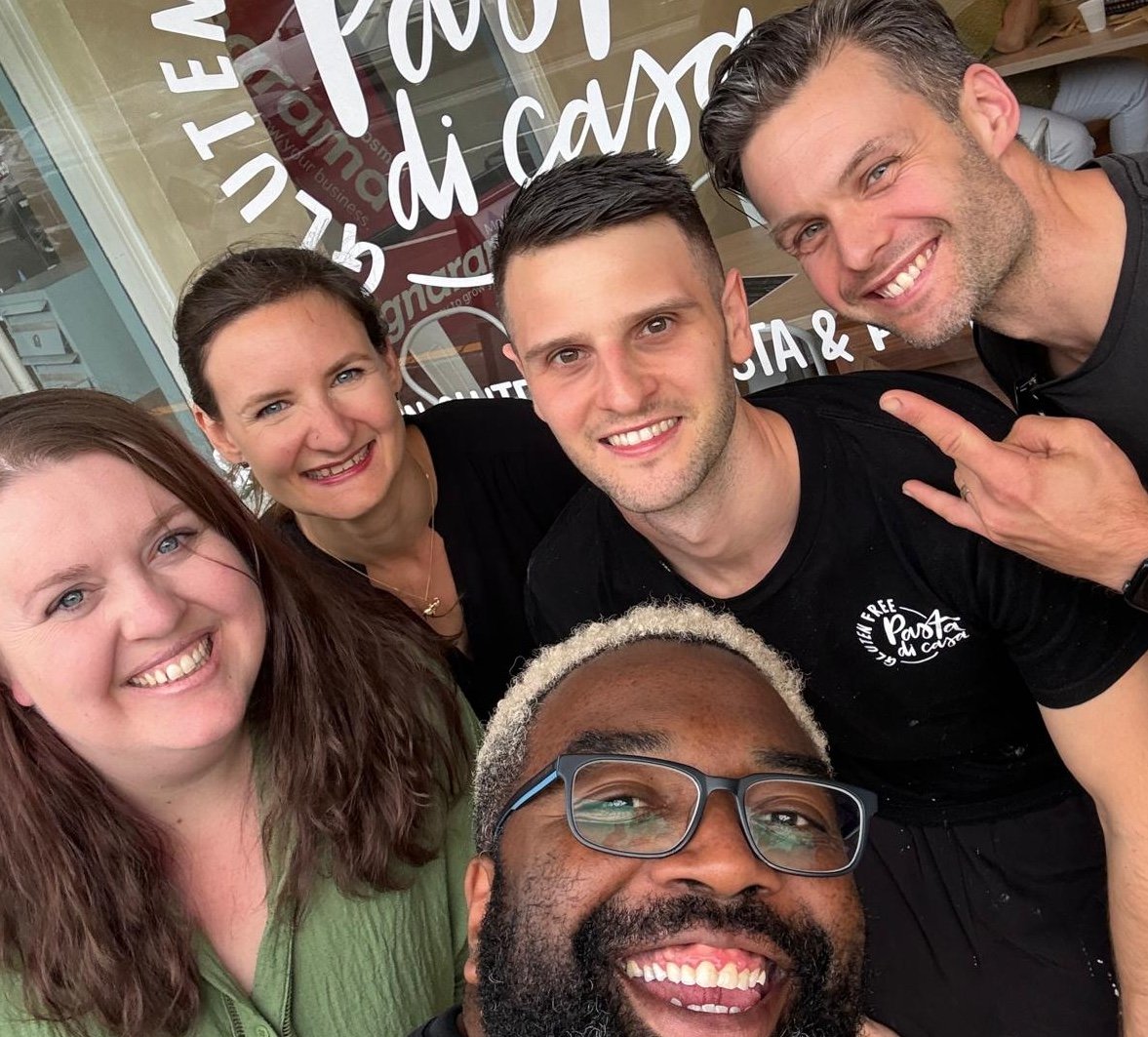
Share the love with your local gluten free small businesses
She also highlights the value of personal recommendations in Facebook groups, especially when brands and content creators are restricted about what they can promote in public groups and settings online.
“Someone doing it for themselves is helpful.”
4) Keep showing up
Perhaps the simplest message came from Sebastien:
“Keep showing up - that’s the main thing. As long as you keep coming - we survive.”
Whether it’s returning to your favourite gluten- free bakery, ordering online, visiting a food truck, attending a market or recommending a business to a friend, those small actions over time can make a difference.
Supporting the Gluten Free Businesses that Support Our Community
The businesses featured in this conversation are all different. There are bakeries, cafes, a food truck, a national food brand, an online gluten free resource and businesses selling directly to customers. But they share something important: they’re creating products, information and spaces for coeliacs and people living gluten free.
They’re also doing it while facing many of the same pressures as other small businesses, alongside the additional hurdles that come with operating in the gluten free food space.
As Anthony says: “We just have to work together and help each other. That’s how we survive… That’s what we do this for. It’s the passion. We want to see smiles on faces.”
And sometimes supporting a business is as simple as leaving a review, sharing a post, telling a friend or saying thank you. Because behind every gluten free small business is a person who has taken a risk, put in the hours and chosen to create something for their community.

Thank you for reading these stories at A Gluten Free Family. If you would like to support the show and help us continue our work to improve awareness, education and make change in the world for coeliac disease and the gluten free diet, subscribe to our Buzzsprout.
We have access to prizes, discounts, ad-free shows, bonus content coming soon and a shoutout on the podcast as well!