A First-Hand Account of NHS Scotland’s Coeliac Prescription by Jj
What does public government subsidy support for coeliacs look like? Jj gives us a first-hand account from Scotland
Share this post:
GUEST BLOG: Jj / @aceliacabroad
I hadn’t even been diagnosed with coeliac disease for a full year when I moved to Scotland to study. I was overwhelmed, not just by the practices of a new country and a new university, but also by a very new disease. Thankfully, this is when I was introduced to Coeliac UK and the NHS Scotland “coeliac prescription.”
All prescriptions in Scotland are free (meaning paid for by our taxes, of course), regardless of the prescription type or prescribing condition. This alone was a shock to my American system – what do you mean, the government doesn’t want to bankrupt people for their medical condition?
Key Principles of NHS Scotland’s Coeliac Prescription

Follow Jj’s global gluten-free adventures via @aceliacabroad
Significantly, though, the NHS in Scotland offers gluten-free staples on prescription to anyone with a coeliac or dermatitis herpetiformis (DH) diagnosis. This is preventative, equitable healthcare in its purest form; giving coeliac or DH patients access to safe GF food reduces their risk of becoming extremely ill.
As a result, it reduces the pressure they’d ultimately place on the NHS if they wound up in a hospital from gluten exposure. NHS Inform (Scotland’s national digital health service) details some of the benefits of the program as “control” and “variety” in diet, and offers an annual health check alongside the prescription, to ensure patients are maintaining their disease properly.
While many other diets benefit from gluten-free food, the NHS only currently recognises coeliac and DH as necessitating the prescription. This is according to their status as autoimmune diseases, and gluten-free food happens to be the only available option for treatment (as opposed to other diseases, which may benefit from going GF, but ultimately have multiple routes of treatment options).
Many feel the GF prescription should be available to a wider array of conditions. I personally agree with that stance, but I am not a doctor nor a policy-maker, and I can only hope that one day there may be more equity in its application.
Validating the Public Prescription Argument
For many who hear of this program, the first question is, “Why can’t coeliacs just pay for their own food, like everyone else?” GF food costs 35-40% more than non-GF alternatives. While the average Scot can walk into a grocery store and walk out with a loaf of bread for 75p, a coeliac would not only need to seek out a store that carries GF bread (as many don’t have a single GF option), but would also have to pay a minimum of 2 GBP for a loaf.
“It has now been 5 years since I moved to Scotland, and every day I am more and more proud to call it my home.”
Over time, this cost stacks up. Further, some individuals like to argue that GF folk should simply avoid processed food entirely and not purchase GF “alternative” foods. According to them, coeliacs should instead eat “naturally” gluten-free items as their entire diet (i.e., meat, vegetables/fruit, rice, etc).
However, even on a diet of these items, the grocery cost would be extravagantly higher than that of the “average” British household. With cost being a major prohibition for so many celiacs and DH patients, the NHS worries that if it came down to it, many may simply go back to eating gluten purely because it’s a financial necessity.
Unit Allocation with NHS Scotland’s Gluten-Free Plan
There is a common misconception the prescription provides a limitless supply of GF items, allowing coeliacs a surplus of GF sweets, biscuits, and other “luxury” items. In actuality, this is not how the prescription operates.
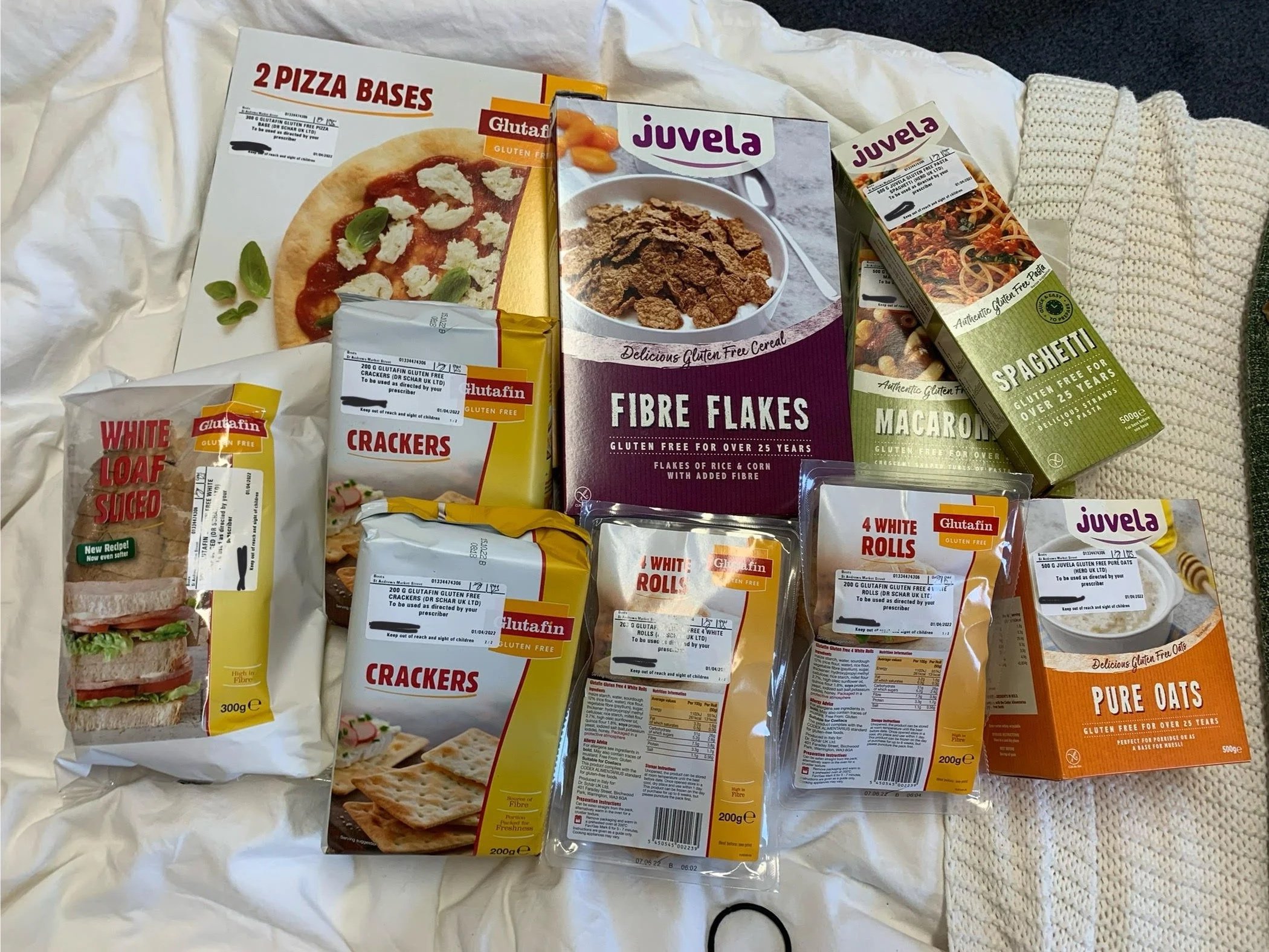
Using NHS Scotland’s unit allocation for gluten-free groceries
Primarily, each patient is prescribed a certain number of “units” per month, based on their gender and age. Younger men, for instance, are prescribed a higher number of units due to the medical community’s assessment they need a higher caloric intake daily than, say, an older woman. Only staple items are available on prescription, and each item “costs” a different number of units.
For example, a box of spaghetti may cost 1.5 units, while a box of GF flour may cost 2 units. While each region can vary slightly in what is on offer, “luxury” and “non-essential” items are prohibited on the prescription, nothing besides the staple bread, flour, etc.
Finally, patients are reminded to only request what they need each month; if they do not feel they need their full unit allocations, they are not required to use them all, with no penalty, but also no rollover of units.
To give you a reference, I am a 23-year-old woman. I receive 14 units per month, but I often only use around 10, as I do not want to be wasteful and find this is the appropriate amount for my lifestyle. I generally get a few boxes of pasta, some oats (as I am a coeliac who tolerates avenin perfectly fine), and occasionally “pizza base” bread, when it is available.
England’s NHS Coeliac Failure Becomes Important Case Study
Interestingly, the NHS in England used to offer this prescription to many individuals. Unfortunately, it has rolled back the program quite extensively, citing budget cuts as the main reason, despite the prescription only amounting to 0.27% of prescribing costs. Not only do most doctors disagree with the decision to repeal GF prescriptions, but some studies are showing that the health complications of coeliacs being “glutened” may outweigh this cost-cut entirely.
The outcome? It created a so-called “false economy” by increasing the risk of much more expensive health complications in the long-term. Wales, on the other hand, has just implemented a new program of their own, providing subsidy cards to coeliacs to offset the cost of GF food; it works like a pre-paid contactless card, which can be used at any supermarket for the purchase of strictly GF items.
It has now been 5 years since I moved to Scotland, and every day I am more and more proud to call it my home. The NHS is ever evolving, and though the continuation of the Scottish coeliac program is never set in stone, I have hope that we will see more programs like this all around the world in the future, as more research is done into celiac disease, and an awareness of the disease’s burden is increased.

About the Author
Jj, formally from Seattle, WA, now lives and works in Scotland. She has always loved to travel and learn from other cultures, so when she was diagnosed with coeliac disease in 2021, she leaned into the global gluten free lifestyle.
Now, she enjoys swapping stories (the good, the bad, and the ugly) of gluten free life with everyone she meets, and her goal is to make travelling less intimidating for all coeliacs and GF-goers.
You can find her on Instagram at @aceliacabroad, or for more long-form content, you can follow her blog, www.aceliacabroad.com. For destination-specific GF recommendations, she is also a Travel Guide for Find Me Gluten Free, as @jjj1234.

Thank you for reading these stories at A Gluten Free Family. If you would like to support the show and help us continue our work to improve awareness, education and make change in the world for coeliac disease and the gluten free diet, subscribe to our Buzzsprout.
We have access to prizes, discounts, ad-free shows, bonus content coming soon and a shoutout on the podcast as well!
References:
Chris Kidd. New CoeliacUK report sheds light on cost, access, and availability of GF food. CoeliacUK. 2025 Feb 10; https://www.coeliac.org.uk/news/new-coeliac-uk-report-sheds-light-on-cost-access-availability-of-gf-food/
McInnes H, Klapan L, Moore U, Singh J, Whelan K. Limited Availability and Higher Cost of Gluten-Free Foods Continue in the United Kingdom: A Comparative Follow-Up Over More Than a Decade. J Hum Nutr Diet. 2026 Feb; 39(1); doi: 10.1111/jhn.70209.
Sara Capacci, Anna Caterina Leucci, Mario Mazzocchi. There is no such thing as a (gluten-)free lunch: Higher food prices and the cost for coeliac consumers. Economics & Human Biology. 2018; 30; 84-91; https://doi.org/10.1016/j.ehb.2018.06.001.
Sha'aban A, Mazzaschi F, Doe E, Ingram BJ, Jones A, Williams E, O'Sullivan H, Evans A, Edwards A, Joseph-Williams N. Patients' views on a subsidy card model for gluten-free food access: a qualitative study. BMC Health Serv Res. 2025 Oct 29; 25(1); 1418; doi: 10.1186/s12913-025-13582-z.
Healthcare bodies call for urgent review. CoeliacUK.2026 Feb 3; https://www.coeliac.org.uk/news/healthcare-bodies-call-for-urgent-review/#:~:text=We%20are%20writing%20to%20you,increasing%20number%20of%20UK%20citizens.