An American Insight into Celiac Disease in the USA

Share this post:
GUEST BLOG: Margaret Clegg
The United States Spells Things Differently
I think one of the most obvious differences between the United States (celiac) and Australia (coeliac) is that we spell the name of this autoimmune disease differently.
I’ve had people comment on my social media posts, absolutely furious about this. As a woman with a minor in French language, I’ve tried to explain to people that the main goal is to communicate with one another.
I think there is enough word similarity that we can still understand what people are trying to say, and that’s the important thing.
How Do People in the United States Get Tested for Celiac Disease?

The gold standard for Celiac Disease diagnosis in the United States continues to be antibody testing and a small bowel endoscopy, while still consuming a diet that contains gluten. There are definitely doctors who will give a diagnosis solely on high tTg antibody levels, per ESPGHAN guidelines.
These are the 4 Celiac Disease antibody tests that should be performed.
tTg IgA
Total serum IgA*
Deanimated Gliadin Peptides (DGP)
Endomysial Antibodies (EMA)
*It is important that patients undergoing Celiac Disease testing have blood drawn to test for Total Serum IgA. As cited by Beyond Celiac, “An estimated 2% of people with celiac disease also have selective immunoglobulin A (IgA) deficiency. If someone has IgA deficiency and celiac disease, the IgA deficiency can cause a false negative on a celiac disease antibody test. Those with IgA deficiency should be tested for IgG-tTG antibodies instead of IgA-tTG .This is because the IgA-tTG test will not be accurate in those with IgA deficiency.”
Many facilities are researching IL-2, which I know Ben has shared about on this blog. This type of testing would remove the requirement to be on a gluten containing diet. My hope is that this will be a reality in the near future.

What Type of Follow Up Care Do United States Celiac Patients Receive?
Sadly, many Celiac Disease patients in the United States don’t receive the follow up care they deserve. Many patients report that they were not referred to a dietitian. Or, if they were, that the dietitian was not knowledgeable about Celiac Disease.
Recently The Academy of Nutrition and Dietetics has created an online Celiac Disease training course specifically for dietitians. In addition, the Commission on Dietetic Registration created a credential for dietitians to be a Certified Specialist in Digestive Health.
Due to the fact that the healthcare industry in the United States is woefully inadequate, many insurance companies don’t cover a dietitian consult. There are legislators in the United States Congress proposing the “Medicare Nutrition Therapy Act,” that would require Medicare to cover dietitian consults for Celiac Disease.
As far as primary care providers, I find I’m advocating for my needs, as many doctors don’t make a point of follow up care. (Gastroenterologists are usually more thorough.) In my blog post about recommended care after a Celiac Disease diagnosis, I share with my followers that the following tests should be run. These include
Repeat TTG lab work
Annual blood draws for nutritional assessment
Thyroid lab tests
Bone Density Screening every 2 years or as needed
Annual Flu Vaccine and Pneumonia Vaccine
Gluten Free Labeling and Certification in the United States
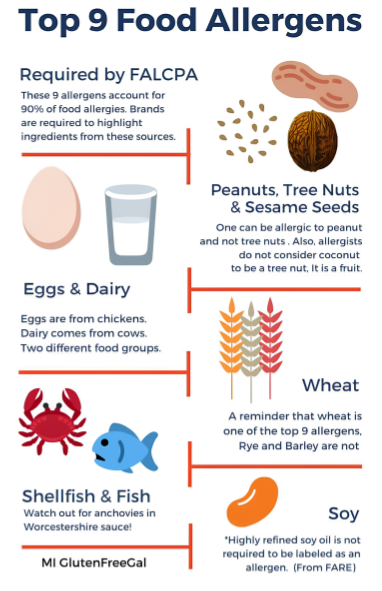
Unlike other countries, the United States does not require all gluten containing grains to be labeled in packaged foods. (There is a push to change this.) At this time, only wheat is required labeling. Currently, the Food Allergen Labeling and Consumer Protection Act requires the labeling of 9 ingredients.
Wheat
Eggs
Dairy
Soy
Peanut
Tree Nut
Sesame
Fish
Shellfish
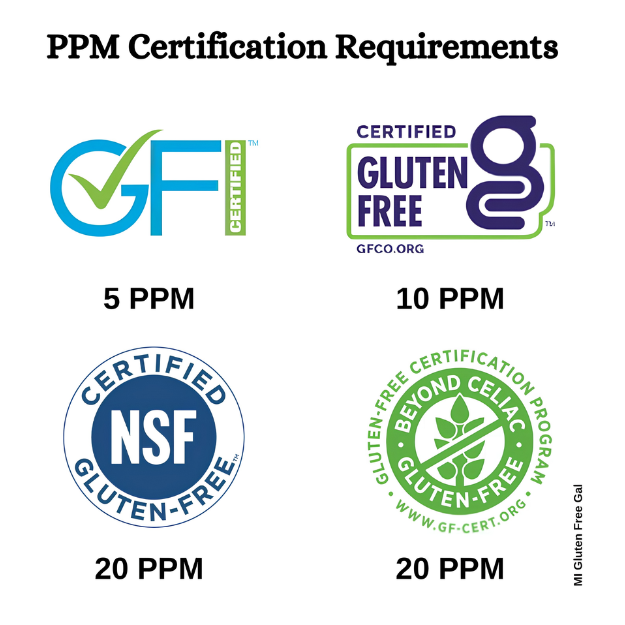
Like many other countries in the world, 20 ppm is the threshold to allow a product to be labeled gluten free. In the United States, manufacturers DO NOT have to test their products for gluten prior to using a gluten free label.
Because of this, many gluten free certification organizations have emerged in the United States.
The Gluten Free Food Program, endorsed by the National Celiac Association, requires products to test under 5 ppm
The Gluten Free Certification Organization, aka GFCO, (owned by the Gluten Intolerance Group) requires products to test under 10 ppm
Menu Trinfo has a new gluten free certification program. They require gluten free products to test under 10 ppm.
The Global Standard Gluten-Free program requires products to test under 20 ppm. It is endorsed by Beyond Celiac in the United States, and the Canadian Celiac Association.
NSF requires gluten free products to test under 20 ppm.
In addition, the Celiac Disease Foundation allows manufacturers who have donated to their non-profit to use their logo on packages. However, this is NOT a certification seal. The Celiac Disease Foundation does NOT test products for gluten.
Do People with Celiac Disease in the U.S. Eat Oats?

Eating oats on a gluten free diet is definitely a hot button topic in the United States. This stems from the fact that farmers grow and harvest oats alongside gluten containing crops, and cross contact is likely.
Certain farmers grow what we call “purity protocol oats” in the United States, taking care to prevent cross contact.
However, there has been an explosion of gluten free products in the United States that contain oats. This includes gluten free oat flour, gluten free whole grain oats, and even gluten free oat milk. For those who avoid oats, it gets trickier each day to find which products are oat free.
You can read more on this topic in my blog post.
Author Bio: Margaret Clegg
Margaret Clegg lives in Lansing, MI with her husband, who has been her biggest supporter. She has been diagnosed with Celiac Disease for over 20 years, and has helped organize gluten free expos, ran a gluten free kids camp, and has helped with research studies. She is most proud of being listed as a featured resource at the University of Michigan for those newly diagnosed with Celiac Disease.
Website link - https://miglutenfreegal.com/
Weekly Newsletter - https://miglutenfreegal.substack.com/
Facebook - facebook.com/miglutenfreegal
Instagram - instagram.com/miglutenfreegal
Pinterest - pinterest.com/miglutenfreegal

Thank you for reading these stories at A Gluten Free Family.
If you would like to support the show and help us continue our work to improve awareness, education and make change in the world for coeliac disease and the gluten free diet, subscribe to our Buzzsprout.
We have access to prizes, discounts, ad-free shows, bonus content coming soon and a shoutout on the podcast as well!